Pioneers and forerunners: this is how the master's programmes EMP (Master's Programme in Environmental Management and Policy) and LUMES (Master's Programme in Environmental Studies and Sustainability Science) can be described. They are some of the oldest interdisciplinary programmes in both Sweden and Europe. Since they started in 1995 and 1997, respectively, they have been extremely popular, with around 1,700 students applying yearly to the master's programmes at The International Institute for Industrial Environmental Economics, IIIEE, and Lund University Centre for Sustainability Studies, LUCSUS.
The students who choose to study in Lund today are increasingly seeking knowledge that can enable them to take positive action, says Maja Essebo, Director of Studies at LUMES.

“Within LUMES, we are putting a greater emphasis on discussing what students can practically do about, for example, climate change or injustice; in contrast to just identifying what is wrong with our world”, says Maja Essebo, researcher at LUCSUS.
Håkan Rodhe, former Director of Studies for EMP, and today responsible for the alumni network at IIIEE, has identified the same trend, but emphasises that the very foundation of EMP has been its practical anchoring in business and policy. The focus has always been that students should be able to immediately apply what they have learned. The same emphasis on practical implementation is also found in MESPOM (Master Programme in Environmental Sciences, Policy and Management), one of the institute's other master's programs, which is even more popular, and §characterized by its genuinely international environment.
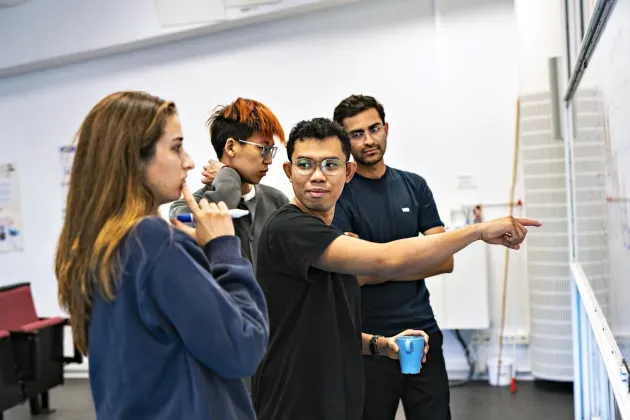
Håkan Rodhe and Maja Essebo believe that there are many reasons as to why so many alumni from EMP, MESPOM and LUMES go on to make an active difference in sustainability and climate work. On the one hand, education and cutting-edge research are integrated, with opportunities to write assignments connected to ongoing research projects, and on the other hand, the programmes integrate practical elements where students get to solve real-world sustainability challenges. Another important factor is the strong sense of unity created within the student cohorts – as they come from different backgrounds, they learn from each other, and often form bonds for life. EMP, MESPOM and LUMES stand out in how they have created a supportive, learning atmosphere, that both current students and alumni describe as life-changing. The atmosphere is actively built through kick-offs, group work and dedicated physical spaces.

“Our alumni return year after year and actively teach in the education. It is a good feeling: that we have created a context that is important, and that gives so much back. Just the other week we had a visit from an alumnus who wanted to show his family: this is where we sat, these were my teachers”, says Håkan Rodhe.
In the future, he wants to involve the alumni even more in the education, because he sees a growing need to practically show what change processes look like in reality. Maja Essebo, in turn, emphasises the importance of pluralism in education.
“We have an important role to play in not becoming too narrow in how we educate in sustainability. In times of polarisation; to teach students to be able to see different perspectives, even those that differ greatly from their own views on life. Pluralism is an important cornerstone in sustainability.”
Maja Essebo and Håkan Rodhe are proud: of the students, the alumni and all the passionate teachers. Being able to follow the students over the years has been a privilege – not least for Håkan, who has been active in EMP for 30 years: starting out as a young doctoral student to later becoming an established researcher.
“Research publications are of course very important, but there are few things that have a greater impact than the students who go out into the world and actually work on these issues”, says Håkan Rodhe.
New international master's programme with a focus on climate change
The UN's annual climate conference is an example of a forum where alumni from Lund University have contributed, including as leaders of Sweden's conference delegation. Last autumn, Lund University launched a new master's programme in climate change and society (LUCAS). It is the first programme of its kind in the world.
“We want to show students how they can work with, and mitigate, climate change in collaboration with others. If they understand the causes and effects of climate change, and how they are rooted in social, economic, political, and cultural complexity, they will also be equipped to do something about it”, says Maja Essebo, who is also responsible for LUCAS.
Sustainability is integrated in all education
Lund University is working actively to integrate knowledge about sustainable development in all its education. Sustainability Forum supports and promotes the integration of sustainability aspects in teaching. Education coordinator Terese Thoni works with skills training for the university’s teachers, focusing on providing support so that they can build up students’ sustainability competencies.
“Since these are broad competences, most teachers can see how they can incorporate them into their education. Sometimes it's just a matter of making the sustainability connection clearer, by including good examples or practices that students can learn from, for example”, says Terese Thoni, education coordinator at Sustainability Forum.